
Bobby Lee Allen: A Veteran’s Record of Service and Honor
Every military story begins with a record, but no military record ever tells the whole story.
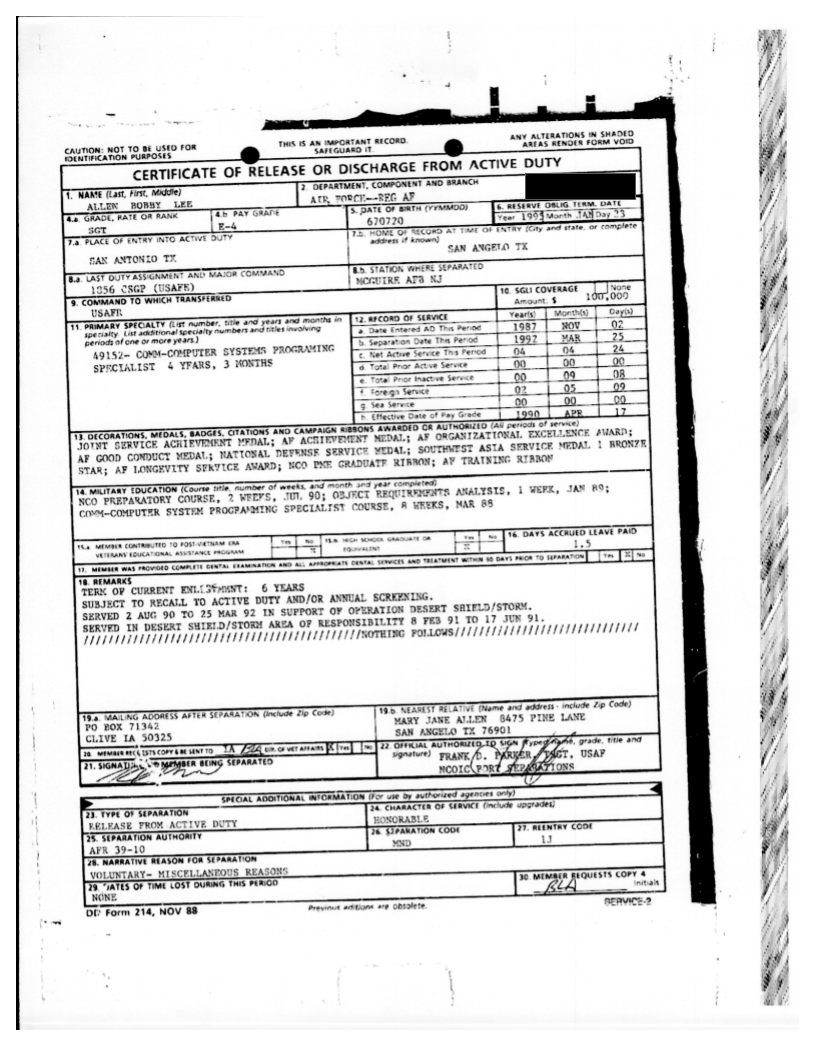
For Bobby Lee Allen, the surviving official summary is a DD-214: a document of dates, duty, rank, training, overseas service, awards, and discharge status. On paper, it is concise. In meaning, it is much larger. It shows that Bobby Lee Allen served honorably in the United States Air Force from November 2, 1987, to March 25, 1992, during a period that spanned the final years of the Cold War and the opening of the Gulf War era. It shows that he worked in a demanding technical specialty, served overseas, supported Operation Desert Shield and Operation Desert Storm, and completed his active-duty career with an Honorable discharge.
That is the official frame. It is also the beginning of a much larger history.
Allen’s Air Force specialty was Computer Systems Programming Specialist, a field that points to the growing importance of military computing and information systems at a time when modern war and modern logistics were becoming ever more dependent on technical precision. It is the kind of work that rarely becomes the center of public storytelling, but it is essential work all the same. Armies and air forces do not run on speeches alone. They run on systems, discipline, timing, maintenance, orders, records, and the quiet competence of people whose work makes larger missions possible.
His discharge record shows overseas service and explicitly notes service in the Desert Shield/Storm area of responsibility from February 8, 1991, to June 17, 1991. That places him in the circle of Americans whose service connected directly to the Gulf War theater. To the general public, Desert Storm is often remembered as a short war. To those who wore the uniform, it was part of a larger period of readiness, deployment, disruption, and duty. A date range on a form may look small to a stranger. To a veteran, those dates can hold an entire world.
Military records also preserve honor in the language of awards.
Among the decorations and ribbons listed on Allen’s discharge are the Joint Service Achievement Medal, Air Force Achievement Medal, Air Force Organizational Excellence Award, Air Force Good Conduct Medal, National Defense Service Medal, Southwest Asia Service Medal with one bronze service star, Air Force Longevity Service Award, NCO Professional Military Education Graduate Ribbon, and Air Force Training Ribbon. Taken together, they do more than decorate a uniform. They describe a pattern of service.
The Joint Service Achievement Medal reflects meritorious achievement or service in a joint military environment, meaning Allen’s work was recognized in a setting that crossed service lines rather than existing only within a single branch. The Air Force Achievement Medal recognizes outstanding achievement or meritorious service, marking performance that stood above routine duty. These are not participation trophies. They are formal acknowledgments that a service member distinguished himself through performance.
The Air Force Organizational Excellence Award points beyond the individual to the quality of the unit in which he served. Military service is never only individual. It is also the story of teams, commands, and organizations that either function well or fail together. A unit award is a reminder that Allen served as part of an organization judged to have performed with exceptional merit.
The Air Force Good Conduct Medal speaks in a quieter register, but no less important one. It marks exemplary behavior, efficiency, and fidelity during honorable enlisted service. In plain language, it means discipline, reliability, and the steady fulfillment of duty. The National Defense Service Medal connects his years in uniform to a nationally significant period of military readiness and conflict. The Southwest Asia Service Medal, with one bronze service star, places his record directly in the theater of the Gulf War era and indicates campaign participation tied to that service.
The remaining honors round out the picture. The Air Force Longevity Service Award reflects sustained honorable service over time. The NCO Professional Military Education Graduate Ribbon points to leadership development and professional study within the noncommissioned officer corps. The Air Force Training Ribbon marks the successful completion of accession training, the beginning of the transformation from civilian to airman. Together, these decorations and ribbons trace a path: entry, growth, discipline, recognized achievement, wartime service, and honorable completion.
On the uniform, these honors would not have been worn as a random collection. They would have appeared in a ribbon rack, ordered by precedence, each ribbon carrying its own meaning while contributing to a single visible summary of service. In Allen’s case, that rack would have told a compact story of achievement, conduct, professional development, unit excellence, national service, and Gulf War theater duty. Even before a word was spoken, the ribbons would have said something about the man wearing them.
At separation, Allen held the rank of Sergeant. That matters too. Rank on a discharge record can seem like a small administrative detail, but in military life rank is responsibility made visible. A sergeant is not simply present; a sergeant is expected to carry standards, solve problems, and lead in the daily reality of service life. That leadership role forms part of the record even when the DD-214 leaves the daily texture unstated.
And that is the great truth about military paperwork: it is both powerful and incomplete.
A DD-214 can tell us when someone served, how they served, what field they worked in, which operations touched their career, what awards they earned, and how the service judged their final record. What it cannot fully capture are the details that veterans carry outside the paperwork — the unit identities remembered years later, the guide-on at basic training, the atmosphere of technical school, the long ordinary days that prepared people for extraordinary demands, the missing records, the lost orders, the copies of copies, and the pieces of a life that official systems failed to preserve.
That missing space is not empty. It is where memory, family history, and recovery begin.
So this account starts where it must: with the discharge paper itself. It starts with what the surviving record can firmly say. Bobby Lee Allen entered the Air Force in 1987. He served in a technical specialty essential to the functioning of modern military systems. He served overseas. He supported Desert Shield and Desert Storm in Southwest Asia. He rose to the rank of Sergeant. He earned awards for achievement, good conduct, training, longevity, professional military education, and service in a joint and wartime environment. And when his active-duty service ended in 1992, the official judgment of that service was Honorable.
That would already be enough to merit respect.
But for a man, a family, or a future book, it is not the ending. It is the foundation. The official record is the spine of the story. Around it will gather the rest: the units, the remembered details, the missing papers, the family military legacy, and the larger history that no one form can hold by itself.
In that sense, Bobby Lee Allen’s DD-214 is not just a discharge. It is the first chapter heading.
<><><><><><><><><><><><><><><><><><><><><><><><><><><><><><><><><><><><><><>
Parry Wayne Allen: Service, Skill, the Quiet Strength of Army Duty, Older Brother of Bobby Lee Allen
Not every soldier’s story is told in headlines. Many are told in specialties, schools, overseas assignments, earned ribbons, and the steady accumulation of trust.
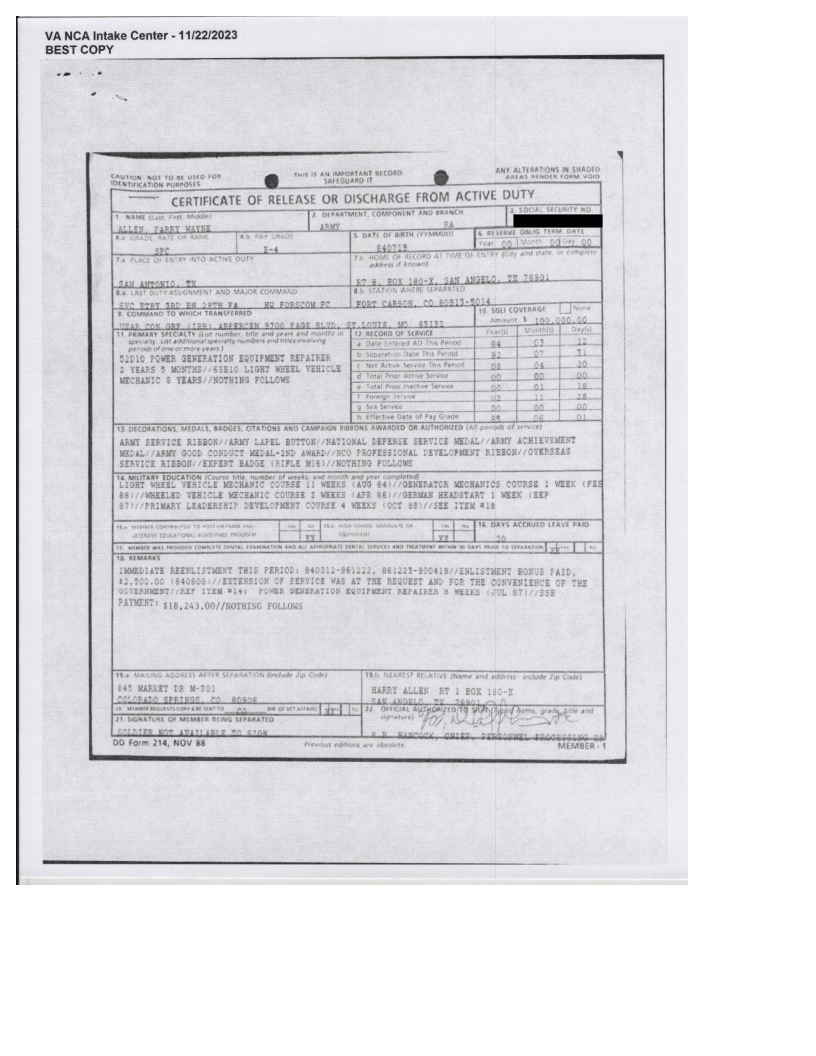
For Parry Wayne Allen, the DD-214 preserves the outline of that kind of service. It shows a man who served in the United States Army from March 12, 1984, to July 31, 1992, rising to the rank of Specialist, E-4, with nearly three years of foreign service and a record centered on technical, mechanical, and operational reliability. It is the record of a soldier whose work was built not around spectacle, but around the hard practical demands that keep an army functioning.
Parry entered service in the middle of the Cold War and remained in uniform into the years when that long geopolitical era was beginning to close. His military occupational specialties and training show the nature of his contribution. The DD-214 identifies him with work as a Power Generation Equipment Repairer and also reflects training and experience in Light Wheel Vehicle Mechanic and related mechanical fields. This is the language of Army sustainment and readiness. Armies move on engines, power, transport, repair, and the labor of people who know how to keep systems running under pressure.
That kind of service rarely gets romantic treatment, but it should not be underestimated. A soldier who can maintain vehicles and power systems supports far more than hardware. He supports mobility, communications, operations, and the daily continuity of military life. In every army, there are those whose job is to make sure other jobs remain possible. That is where much of the real strength lives.
Parry’s discharge reflects honorable, disciplined, and recognized service through its awards and professional development. The decorations listed include the Army Achievement Medal, Army Good Conduct Medal (Second Award), National Defense Service Medal, NCO Professional Development Ribbon, Overseas Service Ribbon, and Army Service Ribbon, along with the Expert Badge with Rifle Bar (M-16) and the Army Lapel Button.
These honors tell their own story.
The Army Achievement Medal reflects notable performance and meaningful contribution. The Army Good Conduct Medal (Second Award) speaks not just to one good stretch of service, but to sustained discipline and fidelity over time. The National Defense Service Medal places his years in uniform within a period of national military significance. The NCO Professional Development Ribbon shows advancement through the Army’s leadership and professional education system. The Overseas Service Ribbon and Army Service Ribbon reflect both the beginning of the Army journey and the reality of service beyond the continental United States. The Expert Rifle Badge adds another dimension: demonstrated weapons proficiency at the Army’s highest qualification level.
His military education section deepens the picture further. The listed courses include Light Wheel Vehicle Mechanic Course, Generator Mechanics Course, Wheel Vehicle Mechanic Course, German Headstart, and the Primary Leadership Development Course. Taken together, these courses show a soldier being shaped not only as a mechanic but as a technically capable and professionally developing member of the Army. They suggest a life of service built on practical skill, adaptability, and preparation.
At separation, Parry left the Army from Fort Carson, Colorado, after years that included substantial foreign service and a work-centered military record. The paper may appear administrative at first glance, but in military terms it says something substantial: this was a soldier who learned difficult trades, carried them over time, served overseas, qualified expertly with his rifle, and earned both recognition and trust.
As with so many service records, the DD-214 is complete in one sense and incomplete in another. It gives dates, rank, schools, specialties, and awards, but it does not narrate the long days behind them. It does not describe the labor of keeping machines ready, the rhythm of Army life, the places overseas where that service was carried, or the private texture of duty that never makes it onto the final form. It preserves the summary, but not the full lived experience.
Even so, Parry Wayne Allen’s record stands clearly enough on its own. It shows a man who served in the United States Army for more than eight years, built his contribution through technical and mechanical skill, served overseas, earned recognition for performance and conduct, and developed within the Army’s professional structure. That is not glamorous service. It is something better: necessary service.
In the larger Allen family story, Parry’s Army record forms a third line beside his father’s World War II Army Air Forces service and Bobby’s Air Force service during the Gulf War era. Together, those lines form a multi-generation record of Americans serving in different branches, different decades, and different kinds of military work. Not all military stories are the same, and that is part of the point. One family can carry war, maintenance, flight, overseas duty, leadership development, technical skill, and honorable service across generations.
Parry Wayne Allen’s DD-214 preserves one part of that inheritance. It records a soldier whose strength was measured in reliability, training, overseas duty, and work done well. In a country that often celebrates only the loudest stories, that kind of service deserves to be remembered too.
—--
Harry W. Allen Sr.: Service, Duty, the Weight of World War II, and Father of Bobby Lee Allen
Every military record is a doorway into a larger history.
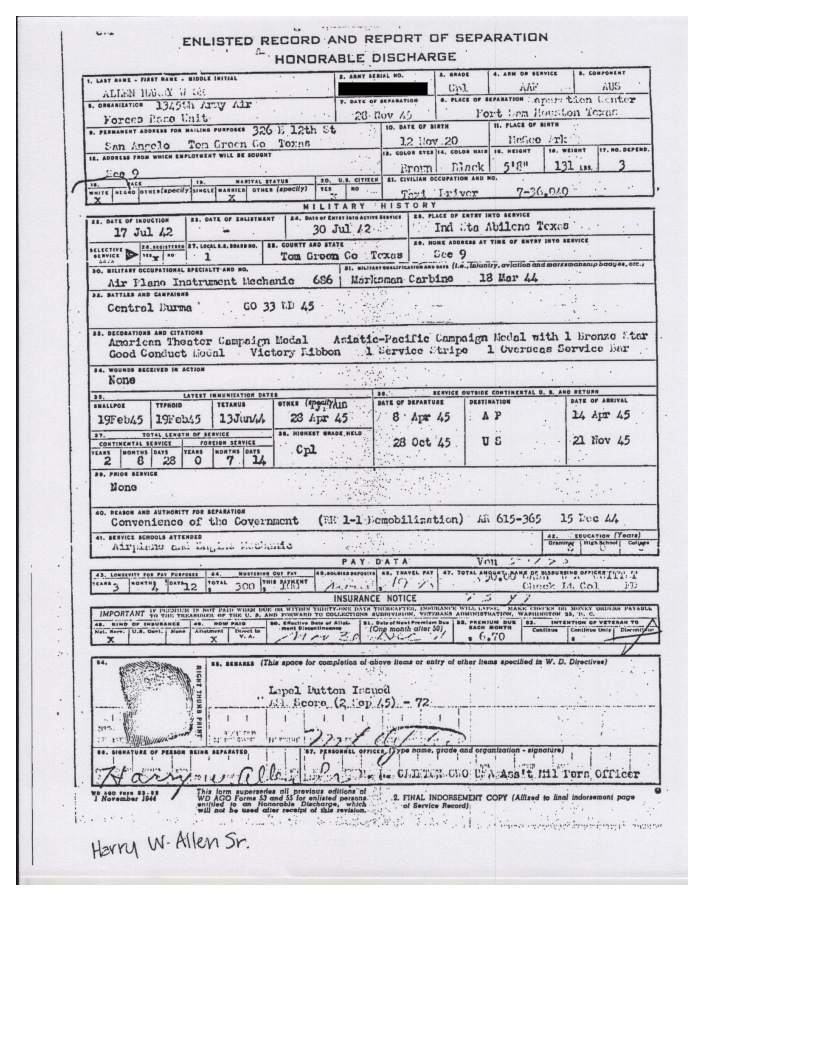
For Harry W. Allen Sr., the surviving discharge paper preserves the outline of a World War II story shaped by duty, machinery, distance, and war on a global scale. The document shows service in the Army of the United States, in the Army Air Forces, at a time when America’s wartime air arm was carrying men, machines, and supplies across some of the hardest terrain and most dangerous routes in the world. It shows that Harry W. Allen Sr. held the rank of Corporal, served as an Airplane Instrument Mechanic, and took part in the Central Burma campaign before his separation in November 1945.
That is the official frame. It is already enough to command respect.
The paper shows that Harry entered active service in July 1942, during the full mobilization of the United States for World War II. His specialty as an Airplane Instrument Mechanic placed him in one of the crucial technical roles of the war. Aircraft did not stay in the air by courage alone. They depended on men who could inspect them, repair them, calibrate them, and keep them reliable under pressure. In a global war fought across oceans, mountains, jungle, and desert, that work was not secondary. It was part of the hidden backbone of victory.
His discharge also records participation in the Central Burma campaign, placing him in the China-Burma-India theater, one of the most difficult and strategically demanding theaters of the war. Burma was a place where terrain, weather, and distance turned logistics into an ordeal. In that setting, aircraft became lifelines. They carried supplies, sustained troops, and helped make Allied operations possible where roads, rivers, and overland routes could not be trusted to do enough. A man serving there as an Airplane Instrument Mechanic was not standing outside the war. He was helping keep the machinery of war alive.
The honors listed on Harry’s discharge trace that service in the language of the era. They include the Good Conduct Medal, the American Campaign Medal, the Asiatic-Pacific Campaign Medal with one bronze star, and the World War II Victory Medal, along with service insignia reflecting overseas duty. Together, those awards tell a concise story of honorable wartime service: service at home, service abroad, participation in a named campaign, and service through the war’s victorious conclusion.
The Good Conduct Medal speaks of discipline and fidelity. The American Campaign Medal ties him to the national military effort that prepared, mobilized, and sustained the war. The Asiatic-Pacific Campaign Medal, marked with a bronze star, connects him directly to campaign participation in the theater where he served. The World War II Victory Medal places his record within the generation that carried the burden of that war to its end. These are not just decorations. They are compressed history.
And yet, as with so many veterans of that era, the official paper leaves much unsaid.
Family memory adds life to the outline. It remembers that Harry fixed the planes and rode on them. It remembers that he flew the Hump in India, placing his story, at least in family understanding, within the dangerous air routes that became legendary in the China-Burma-India theater. Whether every detail has yet been fully documented or not, the discharge itself confirms enough to show that this memory belongs to a real wartime world: Army Air Forces service, aircraft maintenance, Central Burma campaign, and the kind of theater where air operations were not luxury but necessity.
That matters because war records often preserve the skeleton while families preserve the pulse. The paper records branch, specialty, campaign, and medals. The family remembers the planes, the danger, the motion, the lived reality behind the typed lines.
In that sense, Harry W. Allen Sr.’s service belongs to two histories at once. One is the official military history of a corporal in the Army Air Forces who served as an Airplane Instrument Mechanic and took part in the Central Burma campaign during World War II. The other is the family history of a man whose work helped keep the aircraft of war in service, whose duty carried him into one of the hardest theaters on earth, and whose story would become part of a larger line of military service in the Allen family.
Because Harry’s record did not end with him. It became part of a family inheritance: one generation serving in the air war of World War II, another in the Air Force during the Gulf War era, another in the Army in the closing years of the Cold War. In that way, his discharge is not just a closing paper. It is an opening chapter in a multi-generation American story.
The surviving record may be brief, worn, and incomplete. But it still says something that time cannot erase: Harry W. Allen Sr. served in war, served with skill, and served with honor.
The Allen Family: Three Records of Service, One American Line


Some families inherit land. Some inherit money. Some inherit stories half-preserved in memory, in worn papers, in medals, in photographs, and in the way one generation teaches the next what duty looks like.
The Allen family carries a military line of that kind.
Across three men and three eras, the surviving records point to a larger American story: Harry W. Allen Sr. in the Army Air Forces during World War II, serving in the Burma theater; Bobby Lee Allen in the United States Air Force during the Gulf War era; and Parry Wayne Allen in the United States Army during the late Cold War and its aftermath. The branches differ. The decades differ. The specialties differ. But the common thread is service.
Harry W. Allen Sr.’s record reaches back into the greatest war of the twentieth century. His discharge paper places him in the Army of the United States, serving in the Army Air Forces as an Airplane Instrument Mechanic, and credits him with participation in the Central Burma campaign. That alone is enough to place him within one of the most demanding theaters of World War II. Burma was a place where terrain, weather, distance, and supply became decisive military realities. Aircraft were not luxuries there. They were lifelines. A man whose job was to keep aircraft instruments working was helping sustain the larger war effort in a theater where air power and logistics were inseparable.
His awards tell the same story in the language of wartime service: Good Conduct Medal, American Campaign Medal, Asiatic-Pacific Campaign Medal with one bronze star, and World War II Victory Medal. Family memory adds still more life to the record, remembering that Harry fixed the planes and rode on them, and that he flew the Hump in India. Whether every remembered detail has yet been fully documented or not, the discharge itself confirms enough to establish the world he lived in: Army Air Forces, wartime aviation, Central Burma, and honorable World War II service.
That is one line of the family story: the generation shaped by global war.
The second line is Bobby Lee Allen’s. His DD-214 shows service in the United States Air Force from November 2, 1987, to March 25, 1992, ending with an Honorable discharge. His specialty was Computer Systems Programming Specialist, placing him in the technical backbone of a modern military force. His record shows overseas service and specifically records service in the Desert Shield/Storm area of responsibility from February 8, 1991, to June 17, 1991. His awards include the Joint Service Achievement Medal, Air Force Achievement Medal, Air Force Organizational Excellence Award, Air Force Good Conduct Medal, National Defense Service Medal, Southwest Asia Service Medal with one bronze service star, Air Force Longevity Service Award, NCO Professional Military Education Graduate Ribbon, and Air Force Training Ribbon.
That record tells the story of a man who served in uniform during a different kind of war and a different kind of military age. Bobby’s service belonged to the era when computing, systems, and precision had become increasingly central to military effectiveness. It was still a world of rank, readiness, and deployment, but the tools of service reflected a new generation of war-making and support. His record ended at the rank of Sergeant, with awards that reflect achievement, discipline, professional development, and wartime-era duty.
That is the second line of the family story: service shaped by technical skill, Gulf War-era readiness, and honorable Air Force duty.
The third line is Parry Wayne Allen’s. His DD-214 shows service in the United States Army from March 12, 1984, to July 31, 1992, reaching the rank of Specialist, E-4, with nearly three years of foreign service. His specialties centered on the practical machinery that keeps an army moving: Power Generation Equipment Repairer, with training and experience also tied to Light Wheel Vehicle Mechanic work. His awards include the Army Achievement Medal, Army Good Conduct Medal (Second Award), National Defense Service Medal, NCO Professional Development Ribbon, Overseas Service Ribbon, and Army Service Ribbon, along with the Expert Badge with Rifle Bar (M-16).
Parry’s service reflects another side of military life: the technical and mechanical strength without which armies do not function. Vehicles, generators, power systems, and practical maintenance may not carry the glamour of public memory, but they carry the substance of readiness. His schooling and awards show a soldier built through technical competence, overseas duty, discipline, and professional growth.
That is the third line of the family story: Army service rooted in readiness, repair, overseas duty, and steady work done well.
Taken together, these three records form more than a list of veterans in one family. They form a picture of American military service across changing generations.
In Harry’s time, the family line ran through World War II, aircraft maintenance, Burma, and the global fight that defined an age.
In Bobby’s time, it ran through the Air Force, computer systems, Desert Shield and Desert Storm, and the new technical framework of modern conflict.
In Parry’s time, it ran through the Army, power and vehicle maintenance, overseas service, and the practical craft of sustaining military operations.
Three men. Three branches or branch-worlds. Three eras. One inheritance of duty.
What makes the Allen family story especially strong is that it is not a single repeated script. It is not three identical careers. It is three different forms of service, each matching the needs of its time. Harry’s world was one of world war, aircraft, and campaign theaters across Asia. Bobby’s was one of modern air service, systems, and Gulf War-era deployment. Parry’s was one of Army mechanics, readiness, and the technical foundations of operational life. The family pattern is not sameness. It is continuity through difference.
And that may be the most American thing about it.
Military service in one family is rarely just about medals and discharge papers, though those matter. It is also about memory, discipline, sacrifice, family example, and the stories that outlive paperwork. Some details survive in documents. Others survive in what children remember hearing, in the meanings attached to old ribbons, in names repeated across decades, and in the instinct to see service not as abstraction but as obligation.
The Allen family’s surviving records do not tell every detail. There are missing papers, faded lines, half-remembered stories, and further research still to be done. Harry’s World War II record invites more work on unit history and the exact shape of his service in the China-Burma-India theater. Bobby’s Air Force record points toward additional layers still to recover: units, training details, guide-on memories, the missing texture beyond the DD-214. Parry’s Army record also leaves much unsaid about where his foreign service was carried and what daily military life looked like behind the official summary.
But even with those gaps, the pattern is unmistakable.
The Allen family served.
One served in the air war of World War II.
One served in the Air Force during the Gulf War era.
One served in the Army through years of overseas duty and technical readiness.
That is a family history worth recording, not only because it honors the men themselves, but because it tells a larger truth about America. The nation is built not only by presidents, generals, and famous names. It is also built by corporals, sergeants, specialists, mechanics, programmers, repairers, and the countless men and women whose service is real whether history books celebrate them or not.
In that sense, the Allen family record is not a small history. It is American history at the human scale.
And like so many of the best American stories, it is still being recovered.
—---