
Bobby Lee Allen: Service, Honor, and the Making of an American Story
Before there was a campaign, there was service.
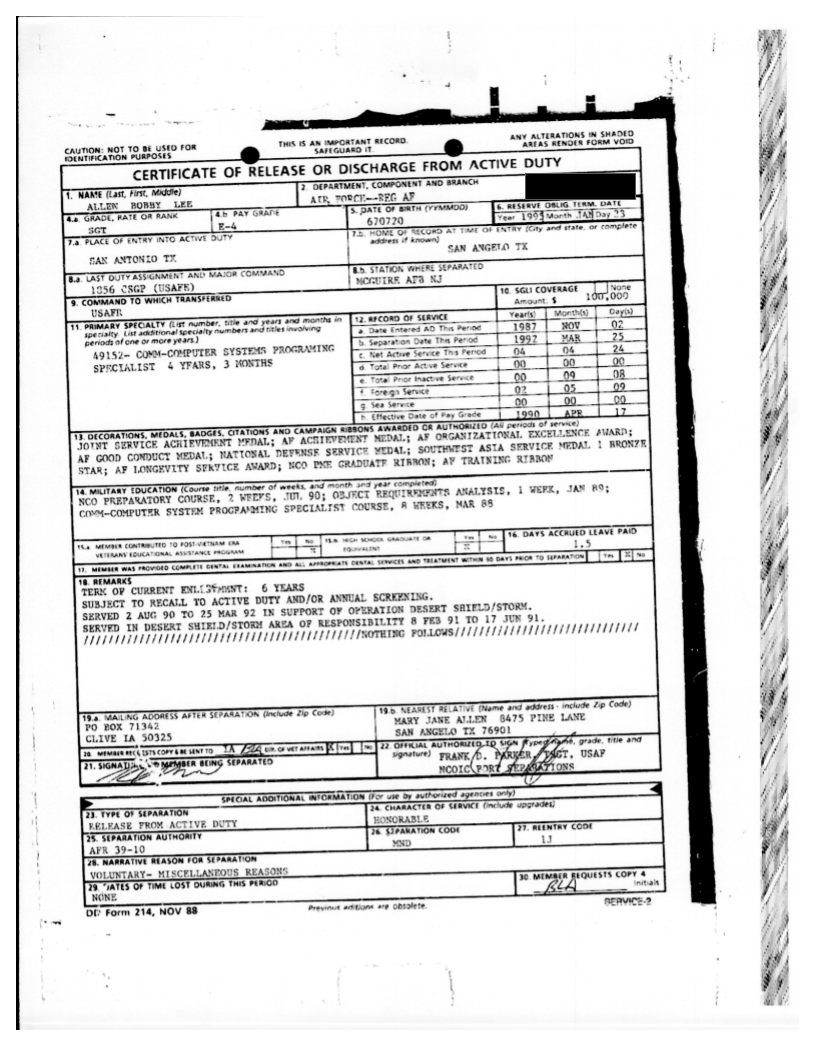
Before there were speeches, websites, interviews, or headlines, there was a young American who entered the United States Air Force on November 2, 1987, and began a chapter of disciplined service that would carry him through one of the defining military periods of his generation. The official record shows that Bobby Lee Allen served on active duty until March 25, 1992, completing his enlistment with an Honorable discharge. That single word — honorable — is not decorative. It is the judgment of the United States Air Force on the character of his service.
Allen served as a Computer Systems Programming Specialist, a role that placed him in the technical backbone of a modern military force. At a time when the world was changing fast, and when war, logistics, communication, and command increasingly depended on complex systems, his work was part of the machinery that made national defense possible. It was not glamorous work for cameras. It was skilled work, disciplined work, and necessary work. In every era, there are those who seek attention and those who carry responsibility. The record places Bobby Lee Allen in the latter category.
His years in uniform coincided with the close of the Cold War and the rise of the Gulf War era. The discharge record shows overseas service and specifically records service in the Desert Shield/Storm area of responsibility from February 8, 1991, to June 17, 1991. That detail places him within the American force that answered the call during a critical moment in international conflict. History remembers operations by name. Veterans remember them by the demands they placed on human lives. The official line on the form is brief. The meaning behind it is not.
The same record documents a service member who did more than pass through the system. Allen’s military honors include the Joint Service Achievement Medal, Air Force Achievement Medal, Air Force Organizational Excellence Award, Air Force Good Conduct Medal, National Defense Service Medal, Southwest Asia Service Medal with one bronze service star, Air Force Longevity Service Award, NCO Professional Military Education Graduate Ribbon, and Air Force Training Ribbon. Taken together, these awards reflect a pattern of service that combined achievement, discipline, unit excellence, professional growth, and wartime duty.
The Joint Service Achievement Medal and Air Force Achievement Medal speak to recognized performance and meaningful contribution. The Air Force Good Conduct Medal reflects discipline, fidelity, and honorable enlisted service. The National Defense Service Medal marks service during a time when the nation called on its armed forces in seriousness, not abstraction. The Southwest Asia Service Medal, accompanied by a bronze service star, ties Allen directly to the Gulf War theater. The NCO Professional Military Education Graduate Ribbon points to leadership formation, while the Air Force Training Ribbon marks the successful beginning of military life. These are not random decorations. They are the visible language of a military career built on standards met, responsibilities carried, and service rendered.
At the time of separation, Allen held the rank of Sergeant. In military life, rank is never merely symbolic. A sergeant occupies the ground where expectations become reality. It is the level of leadership where standards are taught, work is checked, and responsibility ceases to be theoretical. To rise into that rank is to be trusted with more than one’s own performance. It is to become part of the structure that holds the mission together.
And yet, even a strong official record has its limits. A DD-214 is a summary, not a full biography. It captures dates, duties, awards, and final status. It does not contain the whole texture of a life in service. It does not preserve every unit designation, every field of training, every memory from basic training or technical school, every act of leadership, every lost document, every missing order, or every story carried forward by memory when the paperwork is incomplete. The official record is the spine. The full story is larger.
That larger story matters now because the public is not only choosing policies. It is choosing people. In an age of polished branding, shallow resumes, media invention, and synthetic personas, there remains something powerful about a person whose record begins with real service, real duty, and real documentation. Bobby Lee Allen’s story does not begin in a consultant’s conference room. It begins in uniform.
It begins with a man who served his country during war and transition.
It begins with a technical specialist in the United States Air Force.
It begins with overseas service, Gulf War duty, professional education, earned honors, and an honorable discharge.
It begins with a sergeant’s stripes and a veteran’s record.
For some, that would be enough to close the chapter. For Bobby Lee Allen, it may be where the larger American story begins.
Because what stands on the discharge paper is not only a summary of military service. It is proof of tested character. It is evidence of discipline before ambition. It is a record of contribution before recognition. And as the fuller history is assembled — the units, the missing details, the family military legacy, the memories not captured in federal boxes, the life lived before and after service — the official record remains the foundation beneath it all.
In a crowded future field of national figures, many will present themselves as products of strategy. Bobby Lee Allen can present himself as something rarer: a man with honorable service, documented achievement, wartime-era duty, technical skill, and a life story still unfolding into history. That is not a manufactured shine. That is earned light.